
Why Is Building Online Awareness Critical for Your TRT Clinic?
The market for hormone optimization and longevity medicine is experiencing unprecedented growth. As we navigate July 2026, the traditional healthcare model is facing a massive shift.
Patients are no longer content with being told their clinical lab values are “normal” when they are actively struggling with debilitating symptoms like chronic fatigue, brain fog, muscle loss, and low libido.
Instead, they are taking control of their health and turning to personalized, cash-pay longevity medicine.
For a Testosterone Replacement Therapy (TRT) clinic, this shifting landscape represents an incredible business opportunity.
However, it also means you are competing in a highly saturated, aggressive digital marketplace. If your clinic is invisible online, you are losing high-ticket, long-term patients to national telehealth giants and franchise clinics every single day.
Building online awareness is not just about getting more clicks. It is about establishing credibility during a highly sensitive and extended research phase.
Unlike transactional aesthetic procedures, hormone replacement therapy requires a significant psychological and financial commitment. Patients do not simply see an ad and book a treatment.
On average, prospective patients spend 3 to 6 weeks researching their symptoms, treatment options, and local providers before they ever book an initial consultation.
Because of this extended decision-making timeline, a single-channel marketing approach will fail.
To capture these patients, your clinic must implement a comprehensive digital marketing system. This system must be designed to meet patients at multiple touchpoints along their research journey, building trust and authority over time.

Most hormone therapy conversions require 5 to 10 distinct touchpoints before a patient feels comfortable scheduling a consultation.
By building a robust online presence, you ensure that your clinic is visible at every stage of this journey, transforming quiet, private symptom research into a steady stream of loyal, high-value patients.
What Are the Biggest Challenges TRT Clinics Face with Online Advertising?
While the demand for TRT is higher than ever, advertising these services online is a regulatory minefield.
Many clinic owners attempt to run standard digital ad campaigns only to find their accounts suspended, their budgets wasted, and their ads rejected.
Strict Ad Platform Restrictions
The single biggest hurdle for TRT clinics is navigating the strict healthcare and medicine policies of major advertising platforms like Google and Meta.
Because testosterone is a controlled substance, these platforms categorize TRT under highly regulated medical treatments. Globally, 30% to 50% of hormone therapy ads face platform restrictions or outright rejections.
To run ads successfully, clinics must often secure LegitScript certification, particularly if they utilize any online prescribing or telemedicine models.
Furthermore, Google and Meta’s automated compliance algorithms are notoriously sensitive. A single non-compliant word on your landing page, even if it is not in your actual ad copy, can trigger an immediate account suspension.
Google’s “YMYL” Classification
Search engines classify medical and hormone therapy content under the “Your Money or Your Life” (YMYL) category.
Because this content directly impacts a user’s physical and mental well-being, search algorithms hold it to the highest possible standards of E-E-A-T (Experience, Expertise, Authoritativeness, and Trustworthiness).
Anonymous medical copy, unverified claims, or sensationalist promises will result in your website being buried deep in search results.
Societal Stigma and Skepticism
Despite growing mainstream acceptance, testosterone therapy still carries a lingering societal stigma.
Many prospective patients worry about safety, potential side effects, and the long-term commitment of therapy. They are highly skeptical of clinics that feel like “pill mills” prioritizing profit over patient care.
This skepticism is fueled by the broader regulatory landscape.
Articles like The Wild West of Online Testosterone Prescribing highlight the ongoing scrutiny and legal complexities surrounding online hormone prescribing, making patients even more cautious about where they seek care.
Skyrocketing Advertising Costs
Because the market is so lucrative, competition for high-intent keywords is fierce.
In competitive metropolitan markets, the cost-per-click (CPC) for primary hormone therapy keywords ranges from $20 to $80.
If your website is not optimized to convert that traffic, or if your front desk fails to follow up with leads immediately, running paid ads can quickly become a massive financial drain.
At ADvance Media, we specialize in helping elective medical practices navigate these exact hurdles.
We build compliant, highly defensive advertising funnels that protect your ad accounts while driving qualified leads.
To see how we build compliant systems for longevity practices, explore our Longevity Clinic Marketing & Ad Agency services.
How Can Your Clinic Differentiate Itself from National Telehealth Competitors?

To build a highly profitable TRT clinic, you must understand who your real competition is.
It is rarely the local clinic down the street. Instead, your primary competitors are venture-backed, national mail-order telehealth apps.
These digital platforms spend millions of dollars on aggressive, top-of-funnel advertising, offering cheap, hands-off testosterone subscriptions delivered directly to a patient’s door.
While starting an online hormone business has become highly streamlined, as detailed in this Step-By-Step Guide For How To Start a TRT Company, many patients eventually experience “app fatigue.”
They grow tired of automated chatbots, generic customer service, and a complete lack of personalized medical oversight.
This is where your local clinic can win.
By positioning your practice as the high-trust, premium “upgrade” to faceless telehealth apps, you can capture patients who are searching for real, high-quality care.
Referencing resources like The Best Online TRT Clinics of 2026: What to Know Before You Choose can help you understand the exact pain points patients experience with pure-play digital providers, allowing you to position your physical clinic as the superior choice.
The Hybrid Care Advantage
The winning model for local clinics in July 2026 is a hybrid care approach.
You can offer the medical safety and trust of an in-person diagnostic exam and initial consultation, combined with the ongoing convenience of telemedicine for follow-up appointments and prescription refills.
This gives patients the best of both worlds: rigorous clinical safety and modern convenience.
Sell the Membership, Not the Injection
To fund your marketing and outspend your competitors, you must shift your business model away from transactional, per-injection pricing.
Instead, transition to a recurring monthly membership model.
Hormone therapy is a long-term commitment; patients typically stay on treatment for 12 to 36+ months.
By bundling lab monitoring, physician consultations, and medication management into a single monthly fee of $150 to $500+ out-of-pocket, you create a highly predictable recurring revenue stream.
This dramatically increases your Patient Lifetime Value (LTV), giving you the financial leverage to aggressively acquire new patients.
| Feature | Local Physician-Led Clinics | National Telehealth Apps | Franchise Men’s Health Clinics |
|---|---|---|---|
| Care Quality | High-touch, personalized medical oversight | Chatbot-heavy, transactional | Sales-driven, standardized protocols |
| Lab Monitoring | Comprehensive (Total T, Free T, SHBG, etc.) | Basic or self-reported | Standardized, upsell-focused |
| Pricing Model | Recurring monthly membership ($150–$500+) | Cheap entry subscriptions | Per-visit or high-ticket upfront packages |
| Patient Trust | High (local, credentialed doctors) | Low to Moderate (faceless provider) | Moderate (franchise brand) |
| Retention (LTV) | High (12 to 36+ months) | Low (high churn due to app fatigue) | Moderate (sales fatigue) |
How Do You Optimize Your Website and SEO for the Male Patient Journey?
Most TRT clinics make a fundamental mistake with their Search Engine Optimization (SEO): they focus exclusively on “treatment-only” keywords like “TRT clinic near me” or “testosterone injections.”
While these keywords are highly valuable, they only capture patients at the very end of their decision-making cycle, when competition is at its fiercest and cost-per-click is at its highest.
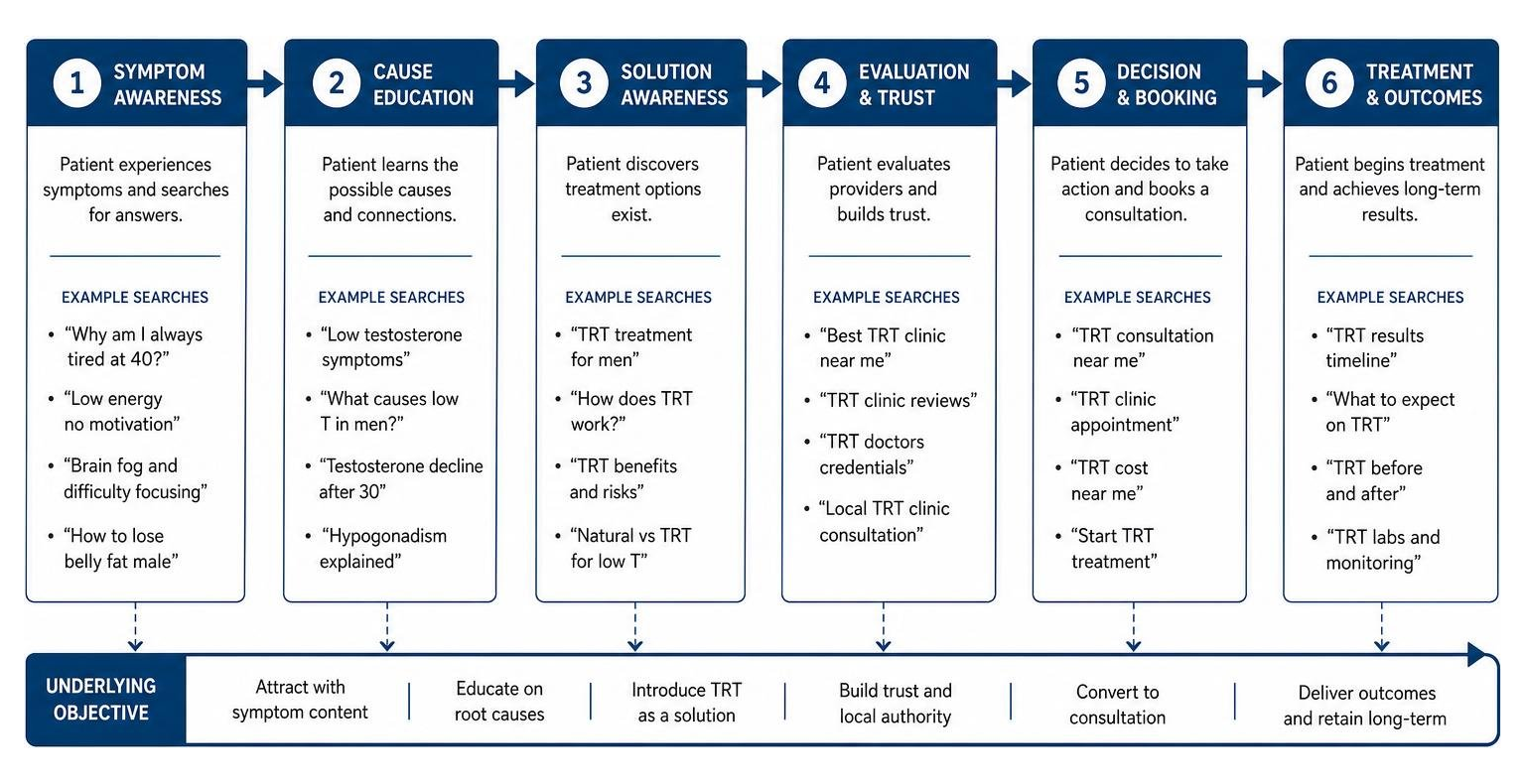
To dominate your local market, you must build a symptom-led SEO funnel.
Men do not wake up and immediately search for “testosterone replacement therapy.”
Instead, they privately search for their symptoms late at night. They search for terms like “why am I always tired at 40,” “how to lose belly fat male,” or “brain fog and low motivation.”
By creating content that ranks for these symptom-based queries, you capture prospective patients weeks before they even realize they need TRT.
The Symptom-Led Content Architecture
To structure your website for the male patient journey, we recommend building a content framework that guides users seamlessly from symptom to solution:
- Symptom Stage: Create detailed, plain-language articles addressing specific symptom clusters (e.g., “Signs of Low Testosterone in Men Over 40” or “Why Am I Exhausted and Gaining Weight?”).
- Cause Stage: Introduce the biological connection between these symptoms and hormonal decline, explaining what hypogonadism is and how testosterone naturally declines after age 30.
- Assessment Stage: Educate patients on how to get tested. Provide highly specific, long-tail content answering questions like “Is 350 testosterone low for a 45-year-old?” or “What is the difference between Free T and Total T?”
- Treatment Stage: Compare different administration methods objectively (e.g., “Injections vs. Creams vs. Pellets” or “Enclomiphene vs. TRT”).
- Outcome Stage: Provide realistic expectations, discussing the timeline of benefits (energy, libido, muscle mass) alongside potential side effects and cardiovascular safety.
Dominating Local SEO and the Map Pack
Because TRT is a local, physical service, optimizing for Google’s Local Map Pack is critical.
The top three Map Pack listings capture 60% to 70% of all local search traffic.
To optimize your Google Business Profile (GBP), ensure your primary category is set to “Men’s Health Clinic” or “Medical Clinic”, and list your specific services individually.
Actively gather authentic, 5-star reviews from your patients. However, because medical privacy is paramount, implement a HIPAA-compliant review workflow where your staff never publicly confirms a patient’s specific treatment in review responses.
To boost your local authority, build consistent citations across authoritative healthcare directories.
For actionable steps on building these, check out our guide on Simple Tips for Creating Local Citations and explore our specialized GMB optimization services.
Satisfying E-E-A-T and AI Search (AEO/GEO)
Because medical content is highly scrutinized, every clinical page on your website must feature named, credentialed provider bylines and medical-reviewer attributions.
This signals to Google’s algorithms that your content is written by qualified experts, boosting your organic rankings.
You can learn more about our approach to building high-ranking medical sites by exploring our dedicated SEO services.
Furthermore, in July 2026, patients are increasingly using AI search engines like ChatGPT, Claude, and Perplexity to privately research sensitive health questions.
To ensure your clinic is cited as an authoritative source by these AI engines, your website must be optimized for Generative Engine Optimization (GEO).
This includes implementing structured schema markup and deploying an llms.txt file.
For a complete blueprint on this emerging channel, read our AEO & GEO Guide for Elective Medical Practices.
What Role Do Paid Ads and Social Media Play in Building TRT Awareness?

While organic SEO builds a compounding, long-term foundation for your clinic, paid advertising and social media act as the immediate accelerators for patient acquisition.
However, to scale these channels successfully without getting your accounts banned, you must execute a highly strategic, policy-compliant playbook.
Writing Policy-Compliant Ad Copy
To pass automated compliance checks on Google and Meta, you must avoid aggressive, direct hormone claims or “before-and-after” body imagery.
Instead, focus your ad copy on the lifestyle benefits, wellness, and vitality that come with physician-guided care.
- Non-Compliant (High Risk): “Boost your testosterone fast! Get rid of erectile dysfunction and build muscle with our TRT injections.”
- Compliant (Low Risk): “Tired of feeling exhausted? Our physician-guided vitality protocols help men over 40 regain their energy, focus, and drive. Schedule a confidential medical evaluation today.”
By focusing on the symptoms and the medical oversight rather than the specific hormone product, you keep your ad accounts safe while still speaking directly to the patient’s pain points.
To discover how we build compliant, high-converting ad campaigns, explore our digital advertising services.
Keyword Targeting and Negative Keywords
When running Google Search campaigns, avoid broad-match keywords like “testosterone” or “hormone therapy,” which will attract unqualified, informational searches and drain your budget.
Instead, use phrase and exact-match keywords such as “TRT clinic near me” or “testosterone doctors in [City]”.
Crucially, you must build a robust list of negative keywords.
Add terms like “DIY TRT”, “bodybuilding” or “steroids” to actively filter out “gym bros” and price-shoppers who are not looking for legitimate, physician-supervised medical care.
The Power of Short-Form Video
On social media platforms like Facebook and Instagram, static images of syringes or generic stock photos perform poorly.
The highest-performing creative format for TRT clinics is short-form provider video (30 to 60 seconds).
Having your lead physician or clinical director speak directly to the camera, explaining common symptoms, discussing safety protocols, or answering FAQs, outperforms static ads by 2x to 4x.
Video builds immediate human trust and clinical authority, which is essential for converting skeptical prospects.
Check out our guide on Medical Social Media and explore our social media marketing services to learn how we script and produce these high-performing assets.
Speed-to-Lead and Automated Nurturing
Generating a lead is only half the battle.
In the cash-pay medical space, your front desk is your highest-leverage marketing tool.
If a prospect fills out a form at 9 PM and does not hear back until the next afternoon, they have already booked a consultation with your competitor.
You must target a speed-to-lead response time of under 5 minutes.
We implement advanced CRM automation that instantly sends a personalized text and email to any incoming lead, allowing them to self-schedule their consultation immediately.
For leads who are not ready to book right away, we deploy automated 30-day email and SMS nurture sequences.
These sequences deliver educational content, address common safety concerns, and gently guide prospects through their 4-to-8 week decision cycle.
This systematic approach is a core element of a successful TRT clinic marketing strategy, which focuses on building trust through consistent, common-sense communication.
To learn more about maximizing your lead conversion, read our guide on How to Generate Leads for Your Medical Practice.
How Do You Measure the Success of Your TRT Online Awareness Campaigns?
To build a predictable, scalable patient acquisition system, you must move away from “vanity metrics” like impressions or social media likes.
Instead, you need to track the hard business metrics that directly impact your clinic’s bottom line.
Critical TRT Marketing Metrics to Track
- Cost Per Click (CPC): Target $5 to $10 on social media; expect $20 to $80 for high-intent Google Search keywords.
- Cost Per Lead (CPL): The cost to acquire a name, phone number, and email. Target: $30 to $60.
- Cost Per Booked Consultation (CPA): The cost to get a qualified prospect scheduled. Target: $60 to $120.
- Customer Acquisition Cost (CAC): The total marketing spend required to get a patient started on an active treatment protocol. Target: $180 to $360.
- Consultation Show-Up Rate: The percentage of scheduled patients who actually show up for their appointment. Target: 60% to 80% (highly optimized by implementing a credit card hold or pre-qualification steps).
- Patient Lifetime Value (LTV): The total revenue a patient generates over their relationship with your clinic. Based on a monthly recurring membership model, a typical TRT patient generates $2,000 to $4,000 in recurring revenue over 12 to 36+ months.
The Growth and Compounding Timeline
When you launch a comprehensive marketing system, you must set realistic expectations for your timeline:
- Months 1–3 (The Foundation): Paid search and social campaigns go live. You should begin seeing measurable lead flow and booked consultations within the first 60 to 90 days.
- Months 4–6 (Data & Optimization): We refine your ad targeting, eliminate low-performing keywords, and optimize your front-desk follow-up to maximize your show-up rates.
- Months 6–12+ (Compounding SEO): Your organic SEO and Google Map Pack optimization begin to rank for high-volume symptom keywords, delivering a highly durable, low-cost stream of patients that reduces your overall blended CAC.
Partnering with ADvance Media
Building, tracking, and optimizing this entire digital infrastructure is incredibly complex.
That is why successful TRT clinics partner with ADvance Media.
We act as your outsourced Chief Digital Marketing Officer (CDMO), taking complete ownership of your website, SEO, paid ads, and CRM tracking.
We build the entire system for you, providing transparent, real-time dashboards so you always know exactly how many dollars of recurring revenue your marketing spend is generating.
Learn more about how we track and scale practices through our tracking technology.
What Are the Most Common Questions About TRT Clinic Marketing?
Can you advertise testosterone replacement therapy on Google and Meta?
Yes, but you must strictly adhere to their healthcare and medicines policies.
Google and Meta restrict direct advertising of prescription hormones. To run these ads, clinics should secure LegitScript certification, particularly if they operate a telemedicine or online-prescribing model.
Furthermore, you must avoid making specific outcome guarantees, using aggressive “before-and-after” imagery, or using prohibited pharmaceutical terms in your ad copy.
Landing page compliance is actually the most common trigger for ad rejections; your website must feature clear medical disclaimers, physician attributions, and HIPAA-compliant forms.
How long does it take to see results from TRT clinic marketing?
Paid advertising campaigns on Google and Meta can begin generating leads and booked consultations within the first 2 to 4 weeks of launching.
However, organic strategies like Local SEO, Google Map Pack optimization, and symptom-led content marketing typically take 3 to 6 months to build authority and rank highly.
Once established, organic SEO becomes your most profitable channel, delivering a continuous stream of patients with zero ongoing ad-spend costs.
Why should a TRT clinic choose a monthly membership model over per-visit pricing?
TRT is clinically an ongoing, long-term treatment process rather than a one-time procedure.
A monthly recurring membership model ($150 to $500+ monthly) matches this clinical reality.
For your business, a membership model stabilizes cash flow, improves patient retention, and dramatically increases Patient Lifetime Value (LTV) to $2,000–$4,000+.
This high LTV fundamentally changes your marketing economics; it allows you to profitably spend more to acquire a patient (CAC), enabling you to easily outspend and dominate competitors who rely on transactional, per-visit pricing.
How Can You Start Building Your TRT Clinic’s Online Presence Today?
Building online awareness for your TRT clinic requires a coordinated, multi-channel system.
By combining a symptom-led SEO strategy that captures patients early in their private research journey, policy-compliant paid ads that act as an immediate accelerator, and rapid lead follow-up driven by CRM automation, you can build a highly predictable, scalable patient acquisition engine.
If you are ready to stop losing high-value patients to national telehealth apps and want to build a dominant local presence, we are here to help.
At ADvance Media, we act as your outsourced Chief Digital Marketing Officer, delivering trackable ROI and compounding growth for your longevity practice.
Ready to future-proof your practice and dominate both search engines and AI answer engines? Just drop us a note here to get in touch and see how we can help audit your marketing and acquisition strategy to build a foundation for growth this year and beyond.
Share this post


