
Do You Need LegitScript to Run Ads for Hormone Therapy and Peptides?
We are currently in September 2026, and the digital landscape for elective medical practices, longevity clinics, and med spas has never been more competitive or more heavily regulated.
If you try to market hormone replacement therapy (HRT), testosterone replacement therapy (TRT), or peptide therapy ads without LegitScript you may run into ad disapprovals or inconsistent review outcomes.
Google, Meta, and other major advertising platforms place healthcare-related paid media under strict scrutiny, and LegitScript has become one of the most important trust and compliance signals in that environment.
Let’s look at the numbers. Applications for LegitScript certification grew 47% from 2022 to 2023, and then nearly doubled again. In the first half of 2024 alone, LegitScript received 94% as many new healthcare certification applications as it received in all of 2023. This massive surge is driven by the cultural explosion of GLP-1 weight-loss medications and advanced peptide protocols.
Because of this, we strongly recommend LegitScript certification for clinics that rely on paid traffic. It may still be possible to run some HRT, TRT, or peptide-related ads without certification, especially if your campaigns avoid restricted drug terms, focus on broader wellness or consultation language, and stay away from high-risk claims. However, that approach is much riskier, less predictable, and more vulnerable to disapprovals, account reviews, or sudden policy enforcement.
At its core, LegitScript is a private, third-party compliance verification and monitoring organization. It is not a government agency, but major search engines and card networks treat it as a gold-standard signal for verifying the legitimacy of online pharmacies, telehealth platforms, and medical merchants.
When you apply, LegitScript conducts a rigorous manual review of your corporate structure, medical licenses, pharmacy partnerships, and website claims. Once you pass, you are granted a certification badge that signals to ad networks and payment processors that your business operates legally, safely, and transparently.
Why Do Google and Meta Scrutinize Hormone and Peptide Advertising?
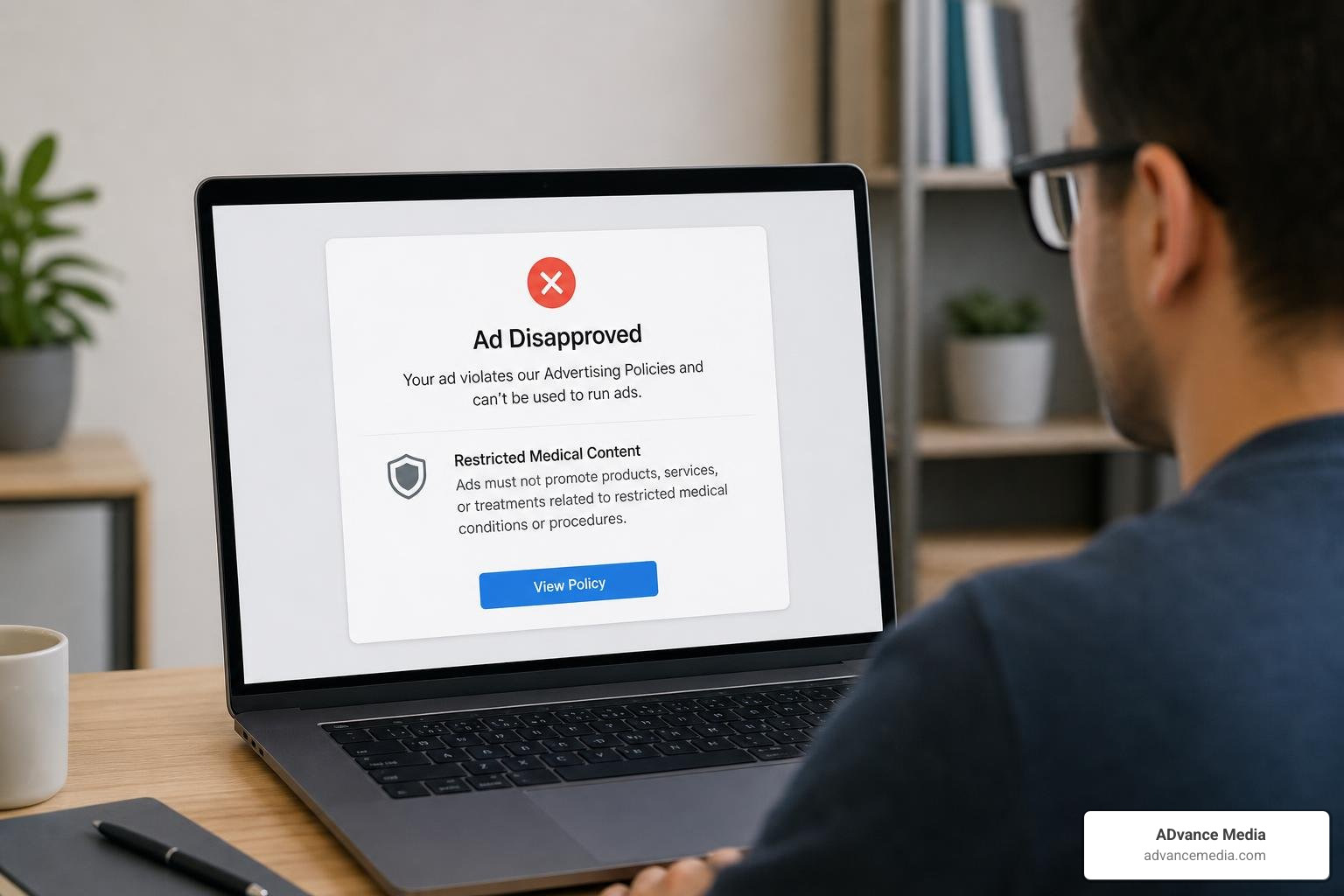
The rise of elective medicine, online health clinics, and telehealth platforms created a Wild West of medical advertising. Unvetted clinics were promoting prescription-only substances with wild, unsubstantiated health claims, creating significant consumer safety risks. To protect consumers and avoid regulatory crackdowns, platforms like Google and Meta established strict policies.
Furthermore, payment processors like Visa and Mastercard use LegitScript as a critical onboarding signal for card-not-present (CNP) transactions under high-risk merchant programs. If you don’t have it, your merchant account can face additional underwriting, holds, or a greater risk of disruption.
According to Google’s official stance on Med Spa advertising, even brick-and-mortar med spas offering prescription-adjacent services may be asked to hold LegitScript certification to run certain ads. Obtaining this certification is the clearest way to unlock restricted ad targeting and keywords, but some advertisers may still be able to run narrower campaigns without it if they avoid restricted terminology and claims.
For a deeper look at what LegitScript represents, check out What LegitScript Actually Is (And Isn’t), Rocket Digital Health and LegitScript Is No Longer Optional, What Every Med Spa and Wellness Clinic Needs to Know | Wellness MD Group. When we manage digital advertising services for our clients, we treat this certification as the safest foundation for a durable paid acquisition strategy.
How Google and Meta Classify Healthcare Advertising
Google and Meta often classify HRT, testosterone, and peptides under their “restricted medical products” and “prescription drug services” policies when ad copy, landing pages, or targeting references regulated treatments directly. Because these substances can require a prescription and medical supervision, automated ad crawlers may flag uncertified accounts that use those terms in ad copy, headlines, or landing pages.
The scale of enforcement is staggering. Violative and problematic advertisements increased 1,200% since 2022. In response, LegitScript monitored more than 500,000 paid search advertisements referencing GLP-1s in just a two-month period. If you attempt to launch campaigns on these platforms without the proper credentials, your ads may be rejected and your account may face escalating review risk. That does not mean every campaign is impossible without LegitScript, but it does mean direct treatment keywords, prescription claims, and aggressive landing page language create a much higher-risk path.
To understand how to navigate these strict channels, we recommend reviewing our guides on Medical Facebook Advertising and Aesthetic Practice Dos and Donts for Running Facebook Ads in 2020.
What Happens If You Run Ads Without Certification
If you attempt to run ads for HRT or peptides without LegitScript certification, you may face ad disapprovals, warning periods, or account reviews, particularly if your campaigns mention restricted treatment names, prescription drugs, controlled substances, compounded medications, or before-and-after style claims. Some clinics try to reduce this risk by using broader wellness messaging, consultation-focused offers, and less restricted keywords. That can sometimes keep campaigns live, but it also limits targeting precision and does not remove the underlying policy risk.
Many clinic owners try to use vague workarounds or alternative spellings (like “s*maglutide” or “BPC-157 alternative”) to bypass automated filters. This is a critical mistake. Google may classify unauthorized pharmacy violations as “egregious,” meaning your account can be suspended immediately upon detection without prior warning, and you may be banned from advertising on the platform.
This crackdown is reflected in the data: med spas flagged for compliance issues spiked 220% in 2024, and 2024 saw a 300% increase in payment processor violations tied to GLP-1 and peptide sales. When payment processors like Stripe, Visa, or Mastercard flag your account for non-compliant online prescribing, they can freeze your merchant accounts and hold your funds indefinitely.
To protect your practice from these catastrophic disruptions, you must understand the evolving landscape of digital advertising. Read more about these challenges in our articles on New Google Adwords Roadblocks and Risk to Your Practice and Google Is Taking Over Your Ads What This Means for Your Practice.
What Are the Specific Rules for Compounded GLP-1s and Peptides in 2026?
The regulatory landscape of peptides in July 2026 is highly nuanced. While some peptides are legally prescribable and compoundable under strict conditions, others are categorically banned from commercial sale and advertising.
Here is a breakdown of how LegitScript and major ad platforms classify various peptides and compounds:
| Compound Category | Examples | LegitScript / Ad Platform Status | Key Compliance Requirement |
|---|---|---|---|
| Approved Compounded GLP-1s | Semaglutide, Tirzepatide | Allowed (with certification) | Must be sourced from a licensed 503A pharmacy during active FDA shortages; must use descriptive terms like “compounded semaglutide” rather than brand names. |
| FDA-Approved Peptides | PT-141 (Bremelanotide), Sermorelin | Allowed (with certification) | Requires a valid patient-specific prescription and medical consultation; no performance-enhancement claims. |
| Research Peptides (Banned) | BPC-157, TB-500, Melanotan II, AOD-9604 | Categorically Banned | Cannot be advertised or sold for human consumption on any certified website. |
| Unapproved Hormone/Weight Loss | hCG (Human Chorionic Gonadotropin) | Banned for Weight Loss | Banned from being promoted for weight loss or weight control, or alongside anabolic steroids. |
To navigate this complex regulatory environment, clinics must align their clinical sourcing and digital presence with the latest compliance standards. For a step-by-step breakdown of telehealth compliance, we recommend reviewing this How to Get LegitScript Certified for Telehealth (2026 Guide) .
Compounded GLP-1s and the “Essentially a Copy” Rules
Compounded GLP-1s represent the fastest-growing segment of medical wellness. Over 60% of new LegitScript applicants focus on weight-loss medications, and of those, a staggering 98% offer compounded GLP-1s. However, marketing these compounded formulations (like semaglutide and tirzepatide) requires strict adherence to LegitScript’s “essentially a copy” rules.
Under FDA regulations and LegitScript standards, a compounding pharmacy cannot compound a drug that is “essentially a copy” of an FDA-approved commercially available drug unless there is an active, recognized FDA drug shortage. Furthermore, your marketing cannot position compounded semaglutide as simply a “cheaper generic Ozempic.” Instead, your website must clearly explain that compounded medications are prepared for individual patients based on a medical practitioner’s prescription and a documented clinical need (such as an allergy to an inactive ingredient in the brand-name drug).
Additionally, you must use precise terminology. You cannot use trademarked brand names like Ozempic, Wegovy, Mounjaro, or Zepbound in a way that implies you are selling those specific products if you are actually dispensing compounded alternatives. Your landing pages must clearly refer to “compounded semaglutide” or “compounded tirzepatide.”
To understand how these rules are reshaping the entire aesthetic and wellness sector, see What Is LegitScript and How Is It Impacting the Medspa Industry? .
The Categorical Ban on Research Peptides
While compounded GLP-1s are permissible under strict guidelines, popular research peptides like BPC-157, TB-500, and Melanotan II are categorically banned from paid advertising. The FDA does not recognize these compounds as approved drugs, and they occupy a high-risk regulatory gray area.
If your website sells or promotes these research peptides alongside approved therapies, LegitScript will deny your certification. LegitScript manually reviews every page of your website, including your blog posts, product listings, and even your social media channels. If they detect unapproved research chemicals, they will flag your domain.
Furthermore, you cannot bypass these rules by bundling these compounds into vague “peptide stacks” or “wellness blends.” LegitScript requires you to itemize all ingredients in any therapy you offer. If a “fat-burning stack” contains an unapproved peptide, your application will be blocked.
How Do You Pass the LegitScript Certification Process for Your Clinic?
Passing the LegitScript certification process is a rigorous, multi-step journey that requires absolute transparency and operational compliance.
To prepare for the application, you must gather a comprehensive set of business and clinical documents. Here is the essential checklist:
- Active Medical Licenses: Verification of active, unrestricted medical licenses for all prescribing physicians, nurse practitioners, and your Medical Director.
- DEA Registrations: Active DEA registrations for all prescribers if your clinic offers controlled substances (like testosterone).
- Partner Pharmacy Credentials: Written proof of your relationship with your compounding pharmacies, including their physical addresses, license numbers, and proof of their own LegitScript certification or VIPPS/NABP accreditation.
- Clinical SOPs: Documented Standard Operating Procedures for patient intake, telehealth consultations, Good Faith Exams (GFEs), and laboratory testing.
- HIPAA-Compliant Privacy Policy: A comprehensive privacy policy published on your website that explicitly names your designated privacy official.
- Unredacted WHOIS Domain Info: Proof that your website domain registration is public-facing and matches your corporate entity.
Once you have gathered this documentation, you will enter a two-phase application process. To ensure your paid campaigns are structured for success once certified, we recommend aligning your digital strategy with our professional Google Ads Management and Facebook Ad Management frameworks. For additional guidance on the intersection of certification and paid media, explore How to Get LegitScript Certified (and Why It Matters for Your … .
Phase One: The Operational and Licensing Questionnaire
Phase One of the LegitScript application is a structured, in-depth questionnaire focused on your business basics, ownership, and clinical infrastructure. LegitScript will require you to disclose a 10-year history of any adverse legal, disciplinary, or regulatory actions against your business, owners, or clinical staff. They will also review any audits or inspections your clinic has undergone in the last five years.
You must verify that all prescribing providers hold active, unrestricted licenses in every state where you accept patients. If you operate a telehealth model, your providers must be licensed in the patient’s home state.
Additionally, you must document your relationship with your partner pharmacies. Under LegitScript Standard 5, your fulfillment pharmacies must be licensed 503A or 503B facilities, and they must hold their own LegitScript certification or recognized pharmacy accreditation. Finally, you must ensure your domain’s WHOIS registration details are completely unredacted and public-facing; anonymous domain registrations are an immediate red flag that will halt your application.
Phase Two: The Website and Social Media Compliance Audit
Phase Two is a manual, highly detailed review of your public-facing digital presence. LegitScript reviewers will comb through your website and social media accounts to identify non-compliant claims, misleading terminology, and regulatory violations.
First, you must remove the word “safe” from all compounded medication pages. Because the FDA does not verify the safety, effectiveness, or quality of compounded drugs before they are marketed, labeling compounded semaglutide or tirzepatide as “safe” is legally prohibited.
Second, you must eliminate any misleading “FDA-approved” claims. For example, if your clinic offers shockwave therapy using a device like GainsWave, you cannot claim the procedure is FDA-approved; while the underlying shockwave technology may have FDA clearance for specific cardiac or lithotripsy indications, the aesthetic or erectile dysfunction procedures themselves are not FDA-approved.
Third, you must scrub your social media accounts of any posts framing testosterone replacement therapy (TRT) as a performance, bodybuilding, or physique enhancer. Several states explicitly prohibit prescribing testosterone or anabolic steroids for muscle-building or aesthetic purposes without genuine medical necessity. Your marketing must frame TRT strictly around diagnosed hypogonadism and clinical need.
Finally, your website must feature a comprehensive, HIPAA-compliant privacy policy that explicitly names your designated privacy official, alongside documented clinical SOPs for patient evaluations, including how you conduct Good Faith Exams (GFEs) and lab testing.
What Are the Costs and Timelines for Certification?
Obtaining and maintaining LegitScript certification requires a significant financial and operational investment.
For a standard healthcare merchant, the pricing structure is as follows:
- Application Fee: A nonrefundable $975 fee per website, paid at the time of submission.
- Annual Certification Fee: A recurring fee of $2,150 per website, billed annually once your application is approved.
- Expedited Review Fee (Optional): An additional $2,500 fee to have a LegitScript analyst begin reviewing your application within two business days.
Without expedited processing, a standard independent review typically takes 3 to 6 months, especially if the reviewer identifies compliance gaps that require website revisions. If you choose expedited processing, the timeline can be reduced significantly, but you must still be prepared to respond cooperatively and quickly to any compliance findings.
It is also important to note that obtaining your LegitScript badge does not automatically activate your ads. Once certified by LegitScript, you must submit a separate, free application to Google and Meta to whitelist your ad accounts. For a comprehensive breakdown of this sequence, see Prescription Drug Google Ads in 2026: Complete Guide + FAQ .
Frequently Asked Questions About LegitScript for Hormone and Peptide Ads?
Let’s address the most common questions clinic owners ask when navigating this complex compliance landscape.
Can I advertise testosterone replacement therapy (TRT) without LegitScript?
Sometimes, yes, but it is risky and highly dependent on the campaign structure, landing page language, platform review, and the specific keywords you use. Testosterone is classified as a Schedule III controlled substance under federal law, so search engines and social media platforms treat TRT marketing with a high level of scrutiny. Campaigns that directly target testosterone, hormone replacement therapy, or prescription-treatment terms are much more likely to be blocked by automated safety filters if your ad account is not certified.
To run TRT ads with the strongest compliance footing, we recommend LegitScript certification, verified state licensing and DEA registrations, and ad creatives that focus strictly on treating diagnosed clinical conditions, such as hypogonadism, rather than promoting muscle mass, athletic performance, or aesthetic body transformation. Without LegitScript, some advertisers may still test broader consultation or men’s health campaigns, but they should understand that this is a higher-risk strategy with a greater chance of disapprovals, limited reach, or account escalation.
What happens if my ad account gets suspended for policy violations?
If your ad account is suspended for “unauthorized pharmacy” or “restricted medical content” violations, do not attempt to create a new ad account or use a different domain name to bypass the ban. This is considered an egregious violation and can result in a permanent ban from the platform.
Instead, you must follow a structured recovery process:
- Audit your website and social media channels to remove all non-compliant claims, unapproved peptides, and restricted drug terms.
- Apply for and secure your LegitScript Healthcare Merchant Certification.
- Submit a formal appeal to Google or Meta, providing your active LegitScript certification ID and screenshots of your compliant website.
To understand how to structure your campaigns to avoid these costly disruptions and maximize your marketing budget, read our guides on Two Big Google Ads Changes Your Aesthetic Practice Needs to Know About in 2020 and Calculating Google Ads ROI.
Does LegitScript certification help with organic SEO rankings?
Yes, but indirectly. While LegitScript is primarily relevant for paid advertising, payment processing, and compliance review, it can also support the trust signals that matter for organic search engine optimization (SEO).
Google evaluates medical and healthcare websites under its strict YMYL (Your Money or Your Life) guidelines. To rank highly, your content must demonstrate exceptional E-E-A-T (Experience, Expertise, Authoritativeness, and Trustworthiness). Displaying the verified LegitScript badge on your website footer, linking to your active certification profile, and aligning your site with rigorous transparency standards can serve as useful third-party trust signals.
For a deeper strategic analysis of how paid ads and organic rankings work together to grow your practice, explore our article: Should I Run Google Ads for a Keyword I Already Rank Well Organically For.
How Can ADvance Media Help You Navigate LegitScript and Scale Your Ads?

Navigating the complex maze of medical compliance, pharmacy sourcing, and digital advertising policies can feel like a full-time job. As a clinic owner, your focus should be on delivering exceptional patient care, not fighting with ad platform algorithms or trying to interpret every advertising policy update on your own.
That is where we come in. At ADvance Media, we act as your outsourced Chief Digital Marketing Officer (CDMO). We do not directly provide LegitScript certification or submit the application on your behalf. Instead, we help you understand how certification fits into your growth strategy, align your website and advertising with compliance-conscious messaging, and, when appropriate, coordinate with a trusted third-party vendor that specializes in the LegitScript process.
We have extensive experience building highly profitable, compliance-conscious marketing campaigns specifically tailored for longevity clinic marketing and medical spa marketing. When you partner with us, we help reduce the friction around LegitScript and paid media compliance without presenting ourselves as the certification provider. Our team can:
- Conduct a pre-advertising review of your website and marketing funnel to identify messaging, landing page, and paid media compliance risks before campaigns launch.
- Help coordinate next steps with a trusted third-party LegitScript vendor if certification support is needed.
- Align your Google Ads and Meta strategy around approved credentials, compliant claims, and lower-risk campaign structure.
- Build and scale high-converting, policy-conscious ad campaigns that drive qualified patient leads while reducing the risk of unnecessary ad disapprovals or account disruptions.
Don’t let compliance hurdles stall your clinic’s growth in 2026. Let us build a sustainable, scalable marketing engine that supports your paid media goals while keeping the right compliance partners involved where needed.
Ready to future-proof your practice and dominate both search engines and AI answer engines? Just drop us a note here to get in touch and see how we can help audit your marketing and acquisition strategy to build a foundation for growth this year and beyond.
Share this post


