
The Stakes Are High When Choosing an Agency for Orthodontic Practice Growth
Table of Contents
- Why Specialization and Tech Integration Matter in 2026
- How to Choose the Best Agency for Orthodontic Practice Growth
- Measuring True ROI and Lead Conversion Systems
- Vetting Agencies: Red Flags, Communication, and Client References
- Frequently Asked Questions about Orthodontic Marketing
- Conclusion
Knowing how to choose the best agency for orthodontic practice growth could be the single most important business decision you make this year. The right partner fills your schedule with new patient starts. The wrong one burns your budget on clicks that never convert.
Here is a quick answer to help you decide fast:
How to choose the best agency for orthodontic practice growth:
- Verify orthodontic specialization: not just general dental or healthcare marketing experience
- Demand outcome metrics: cost-per-start and patient starts, not clicks or impressions
- Confirm AI search readiness: ask if they have a Generative Engine Optimization (GEO) strategy for ChatGPT and Gemini
- Check technology integration: CRM, call tracking, and automated lead follow-up
- Ask for verifiable case studies: specific to orthodontic practices, from the last 12 months
- Test their communication: call their office unannounced before you sign anything
- Confirm you own your assets: website, ad accounts, and content should belong to you
- Request client references: and actually call them
Over 67% of people now prefer to book appointments online. Yet most orthodontic practices are still choosing marketing agencies the way they might pick a general contractor, based on a portfolio and a price. That mismatch is expensive.
The orthodontic market is not the same as general dentistry. The patient decision cycle is longer. The average treatment value is higher. And the local competition is fiercer than ever.
A generalist agency treating your Invisalign campaign like a tooth-cleaning promotion is not just inefficient. It actively costs you starts.
This guide walks you through exactly what to look for, what to avoid, and what questions to ask before you sign with any agency.
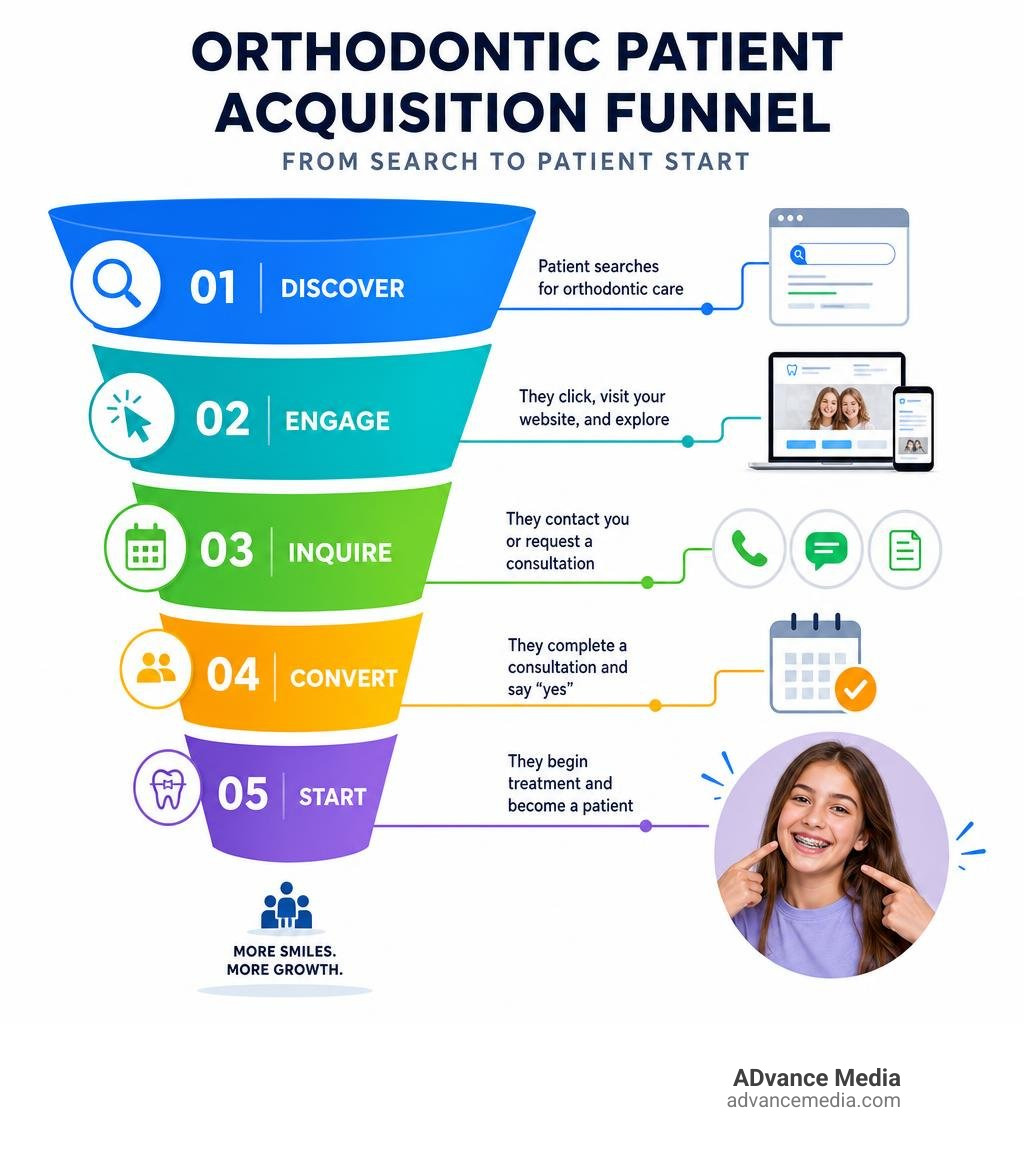
Why Specialization and Tech Integration Matter in 2026
The digital landscape of 2026 is unforgiving. With search engine algorithms updating hundreds of times per year and AI-driven search models changing how patients seek care, a “one-size-fits-all” marketing approach is a recipe for empty chairs.
Orthodontic marketing requires a deep understanding of clinical nuance and patient psychology. Parents researching early interceptive treatment for their seven-year-old behave differently than a working professional seeking clear aligners.
Furthermore, orthodontics is fundamentally local. Statistics show that 80% of orthodontic patients choose a provider located within a 10-mile radius of their home or work. This hyper-local reality means your local patient acquisition strategies must be incredibly precise. A generic agency running broad, city-wide campaigns will waste your budget on clicks from people who will never drive to your clinic.
Why Specialization Matters When Deciding How to Choose the Best Agency for Orthodontic Practice Growth
Hiring a generalist agency to grow your orthodontic practice is like taking a high-end sports car to a neighborhood lawnmower mechanic. They both have engines, but the internal mechanics are worlds apart.
Many general dental marketing agencies treat general dentistry and orthodontics interchangeably. However, this clinical oversight is costly: studies show that treating these two distinct fields identically in marketing strategies can lead to a 35% decrease in lead quality due to mismatched search intent.
General dentistry addresses immediate, high-frequency needs like cleanings, fillings, or toothaches. Orthodontics, on the other hand, involves a high-value, elective purchase with a long, research-heavy sales cycle typically spanning 4 to 8 months.
To capture these high-value Invisalign or braces starts, an agency must understand:
- The Clinical Lexicon: Creating content that explains Class II malocclusions, Phase I vs. Phase II treatments, or the difference between ceramic brackets and clear aligners without sounding like a dry medical textbook.
- The “Observation Pool” Opportunity: Up to 45% of an orthodontic practice’s future revenue is trapped in pre-treatment monitoring (the observation pool). Generalist agencies ignore this, focusing only on immediate leads, while a specialist knows how to keep these families engaged.
- The Parent Persona: High-income parents are protective of their children’s health and their family budget. In fact, 68% of high-income parents won’t book a consultation if a website’s content feels “canned,” repetitive, or template-based.
To dive deeper into why standard digital marketing strategies fail to move the needle for modern practices, read our detailed breakdown on Why Good SEO Is Not Enough for Orthodontic Practices Anymore.
Generative Engine Optimization (GEO) and AI Search in 2026
We have officially entered the era of AI-first search. While 93% of all online experiences still begin with a search engine, the way those engines present information has fundamentally shifted. Patients are no longer just typing keywords into a search bar; they are asking conversational questions to AI assistants like ChatGPT, Gemini, and Perplexity.
This shift has given rise to Generative Engine Optimization (GEO). If your agency is only optimizing for traditional blue links, your practice will remain completely invisible in AI-generated summaries.
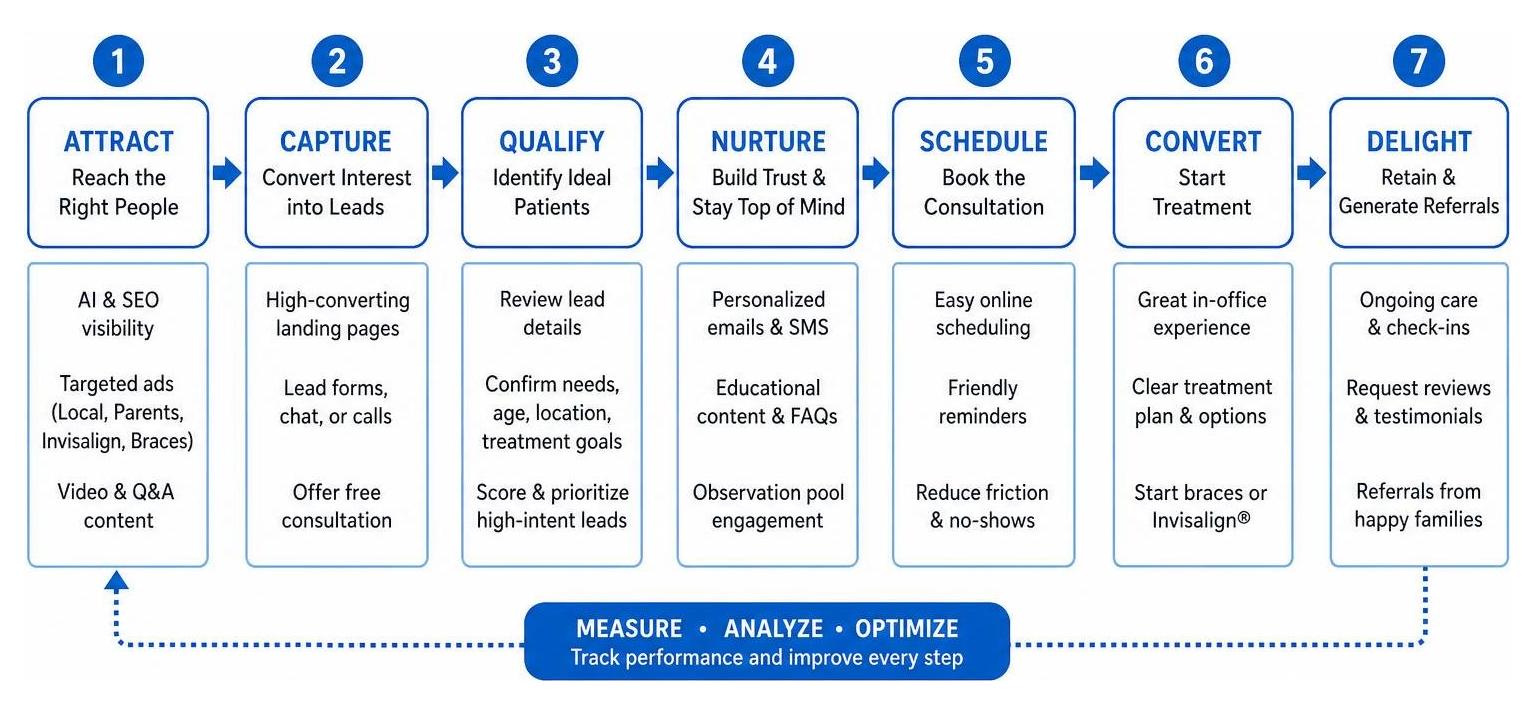
To win in 2026, your agency must optimize your digital footprint so AI engines trust and recommend your practice. AI search engines rely heavily on:
- Third-Party Review Signals: Consistently feeding search engines high-quality reviews from platforms like Google, Healthgrades, and WebMD.
- Video Content as a Trust Signal: In 2025, video streaming accounted for 85% of all internet bandwidth. AI engines and Google heavily weight original video content (such as doctor introductions, patient FAQs, and office walkthroughs) as a primary quality signal. Practices utilizing custom videos on their landing pages see a 34% increase in conversion rates.
- Structured Q&A Content: Publishing highly specific, clinically accurate answers to the direct questions patients ask AI engines.
To understand how to position your clinic in this new digital landscape, read our analysis of SEO vs AEO vs GEO for Orthodontists: What Actually Matters in 2026. You can also discover how to structure your clinical content to capture these AI-driven queries in our guide on How Treatment-Specific Guides Help Your Orthodontic Practice Show Up in AEO/GEO.
The Modern Orthodontic Tech Stack: CRM, Call Tracking, and AI Follow-Up
In 2026, a marketing agency’s job cannot end at lead generation. A lead is completely useless if it sits in an unread email inbox.
The math is brutal: 68% of orthodontic leads fail to reach a consultation chair due to internal follow-up delays exceeding 24 hours. Even worse, a 5-minute delay in responding to an online inquiry decreases lead qualification odds by 80%. Your front-desk team cannot handle this speed manually while managing in-office patients.
A modern orthodontic marketing partnership must integrate advanced technology directly into your practice workflows:
- Practice Management CRM Integration: Your marketing campaigns must sync seamlessly with systems like Dolphin, Cloud9, or Gaidge. This allows us to track a patient from their first organic click or paid ad all the way to their signed treatment contract.
- Call Tracking and Recording: Every phone call must be tracked to its source (SEO, Google Maps, PPC, or social media) and recorded to audit how your team handles incoming inquiries.
- AI-Powered Missed Call Recovery and Follow-Up: If a prospective parent calls your office at 8:00 PM on a Sunday, an AI system should immediately text them back to start a conversation and offer a self-scheduling link.
By automating these initial touchpoints, you eliminate “lead leaks” and ensure no opportunity is wasted. To see how we build these intelligent systems for elective medical practices, explore our specialized AI Visibility AEO GEO Services.
How to Choose the Best Agency for Orthodontic Practice Growth

Choosing the right marketing agency is a critical growth decision. To achieve local market dominance, you must look past flashy sales pitches and evaluate an agency’s actual capabilities, reporting structures, and strategic alignment.
Full-Service Growth Partner vs. Creative Branding Specialist
Before you start interviewing agencies, you need to determine what your practice actually needs. Are you looking for a creative branding specialist or a full-service growth partner?
- Creative/Branding Specialists: These agencies are excellent at designing beautiful logos, choosing color palettes, and producing high-end office photography. They make your practice look incredible. However, they rarely build the conversion funnels, local SEO strategies, or lead-tracking systems required to scale your business.
- Full-Service Growth Partners: These agencies (like us at ADvance Media) act as your outsourced Chief Digital Marketing Officer (CDMO). We tie creative assets directly to performance marketing. We optimize your website for conversions, run high-intent paid campaigns, manage your local search presence, and integrate CRMs to track actual patient starts.
If you are a brand-new practice, you may need a basic brand identity first. But if you are an established practice looking to scale, you need a partner focused on growth infrastructure.
To weigh the pros and cons of outsourcing your growth strategy, read our article: Hiring a Professional Marketing Growth Agency: Is It Worth It in 2020?. You can also read our strategic comparison for practice owners: Aesthetic Practice Owners: Marketing Efforts vs. Agency.
Realistic Timelines: SEO vs. Paid Advertising
Any agency that promises to double your patient starts in 30 days is lying to you. A healthy marketing strategy balances short-term wins with long-term digital equity. You must understand the realistic timelines of different digital channels:
- Paid Advertising (PPC & Meta Ads): This is your short-term scaling lever. Paid search and social media campaigns can begin generating patient leads within weeks of launching. It is highly effective for capturing immediate local demand, but it requires ongoing ad spend to maintain. Explore how we build these high-converting campaigns via our Digital Advertising Services.
- Search Engine Optimization (SEO): SEO is a long-term investment that builds a competitive moat around your practice. While technical fixes can show minor visibility improvements within 30 days, meaningful organic traffic and consistent lead volume typically take 4 to 9 months to develop. However, once established, organic search delivers the lowest cost-per-acquisition of any channel. Learn more about our technical and local optimization frameworks on our SEO Services page.
Measuring True ROI and Lead Conversion Systems
If your current marketing agency sends you monthly reports filled with graphs showing “impressions,” “clicks,” or “website sessions,” they are performing marketing theater. You cannot pay your staff or your practice rent with clicks. You need to focus on actual business outcomes.
| Metric Type | What It Tracks | Why It Can Be Misleading |
|---|---|---|
| Vanity Metrics | Impressions, Clicks, CTR, Page Views | High traffic does not equal high revenue. A beautiful website with thousands of visits can convert at 0% if it lacks clear conversion paths. |
| Middle-Funnel Metrics | Cost-Per-Lead (CPL), Raw Form Submissions | Leads can be low-quality or out of your geographic area. A “cheap” $10 lead is expensive if they never pick up the phone. |
| True Outcome Metrics | Cost-Per-Start, Exam-to-Start Conversion Rate, Patient Starts | This directly measures business growth and actual revenue generated from your marketing investment. |
Practices that shift their focus from generic templates to highly specialized, niche-specific orthodontic strategies see an average 22% higher conversion rate.
Beyond Vanity Metrics: Tracking Patient Starts and Cost-Per-Start
To measure the true ROI of your marketing spend, you must track the metric that actually matters: new patient starts.
By calculating your total marketing spend against your actual starts, you find your true Cost-Per-Start. For example, if you spend $3,000 on a campaign and generate 6 verified patient starts, your Cost-Per-Start is $500. Given that the lifetime value of an orthodontic patient ranges from $5,500 to $7,000, that is an exceptional return on investment.
To achieve this level of tracking, your agency must set up advanced multi-touch attribution using Google Analytics 4 (GA4) and your CRM. This ensures that when a parent searches for “Invisalign for teens,” reads an educational guide on your site, and eventually books a consult, that start is accurately attributed to the correct organic campaign.
Evaluating Lead Conversion and Team Enablement
A common complaint from orthodontists is: “My agency is generating leads, but they are all bad leads.”
In our experience, there are rarely “bad leads” from digital marketing, only broken follow-up and conversion practices within the clinic. If your front desk takes 24 hours to call a web inquiry, that lead is cold.
A true growth partner doesn’t just hand over leads and walk away; they actively enable your internal team to close them. This includes:
- Training Your Treatment Coordinator (TC): Helping your TC optimize their Exam-to-Start conversion rate (aiming for a healthy 60% to 75% benchmark).
- Implementing Same-Day Starts: Setting up operational protocols so high-intent patients can get their brackets bonded or digital scans taken the very same day as their consultation.
- Frictionless Website Design: Ensuring your website answers critical patient questions above the fold and makes booking a consultation incredibly simple.
To understand how modern patients navigate this decision-making process, read our deep-dive analysis on The Hidden Funnel: How Patients Actually Choose an Orthodontist in 2026. To audit your own site’s conversion potential, check out 5 Questions Every Orthodontic Site Should Answer Above the Fold.
Vetting Agencies: Red Flags, Communication, and Client References

The digital marketing industry has a massive trust problem. The national average turnover rate for marketing agencies is 30% annually, and many small digital marketing firms lose up to 50% or more of their clients every single year due to poor results and lack of communication.
Protect your practice by thoroughly vetting potential partners.
Critical Red Flags of Outdated or Risky Marketing
When interviewing prospective agencies, keep an eye out for these critical red flags. If you encounter any of them, walk away immediately:
- Guaranteed Google Rankings: No one controls search engine algorithms. Anyone guaranteeing the #1 spot is using outdated, risky “black-hat” tactics that could get your website penalized or completely removed from Google search results.
- Canned or Duplicate Content: Many cheap agencies use identical blog posts and service pages across hundreds of orthodontic websites nationwide. Not only does this hurt your SEO, but 68% of high-income parents will abandon your site if your content feels generic.
- Locked-In, Long-Term Contracts with No Way Out: If an agency demands a 12-month contract with no performance-based exit clauses, they are trying to lock you in because they know their client retention is poor.
- Proprietary Website Platforms: Some agencies build your website on their own custom software. If you decide to leave them, they keep your website, your content, and all your SEO history. You should always own your digital assets.
To safeguard your marketing budget, read our guide on the Top 5 Ways to Avoid Getting Ripped Off by a Marketing Agency.
Assessing Communication, Transparency, and Reporting Style
A great agency partnership is built on radical transparency. You should never have to wonder what your marketing team is doing or where your money is going.
Before signing a contract, ask how they handle reporting and communication:
- Do they provide a live, real-time dashboard? You should be able to log in at any moment to see your ad spend, cost-per-lead, and verified patient starts.
- Will you have a dedicated account strategist? You do not want to be passed off to a basic support ticket queue or an intern. You deserve an expert who understands your business.
- How quickly do they respond? Test them during the sales process. If they take days to reply to your initial inquiry, imagine how slow their communication will be once they have your credit card on file.
For a comprehensive checklist of what a healthy agency relationship looks like, read our resource on What to Look for in a Digital Marketing Agency. To understand where the agency industry is heading as a whole, read Is This the Beginning of the End of Marketing Agencies?.
Key Questions to Ask When Learning How to Choose the Best Agency for Orthodontic Practice Growth
When you are ready to interview agencies, do not just let them show you their best portfolio screenshots. Ask these direct, performance-focused questions:
- “Can you provide a list of three current orthodontic references I can call directly?” (When you call them, ask how long they’ve been with the agency and if they’ve seen a measurable increase in treatment starts).
- “Do you offer local market exclusivity, or are you working with my direct competitors down the street?” (It is an ethical conflict of interest for an agency to try to rank two competing local orthodontists for the exact same high-intent keywords in the same zip code).
- “Do I retain 100% ownership of my website, ad accounts, and custom content if we decide to part ways?”
- “How do you integrate with my practice management software to track cost-per-start?”
Frequently Asked Questions about Orthodontic Marketing
How much should an orthodontic practice spend on marketing?
A common industry benchmark for established orthodontic practices is to allocate 3% to 6% of gross revenue to marketing, with digital channels accounting for the vast majority of that budget. For high-growth practices or new startups looking to aggressively capture market share, this investment can range from $2,500 to $10,000+ per month (excluding direct ad spend).
Your website is the foundation of this investment. If you are sending paid traffic to an outdated site, you are throwing money away. Explore our custom Website Development Services to ensure your digital storefront is built to convert.
Why is local SEO more important than national SEO for orthodontists?
Because orthodontics is a hyper-local business. Over 92% of prospective patients choose an orthodontist located within a 15-mile radius of their home or school. Ranking for national search terms does nothing to fill your local clinical chairs.
Dominating the Google Map Pack (the top three local map results) is critical, as it accounts for 44% of all local clicks. To understand how to optimize your practice for local search dominance, read our guide on Why the Google 3-Pack Matters for Orthodontists. If your practice is located outside of a major metropolitan area, you may also have a massive untapped opportunity; learn more in our article on Why Orthodontists in B/C Markets Have a Hidden Growth Advantage.
Can AI completely replace a marketing agency for my practice?
While AI tools are incredible for automating repetitive tasks—like drafting initial content ideas, sorting local keywords, or triggering immediate text message follow-ups—AI cannot replace high-level human strategy. AI lacks the ability to understand your unique local community, build real human relationships with local dentist referral networks, or navigate the complex clinical nuances of your specific practice brand.
A successful marketing strategy uses AI as an accelerator, guided by experienced human marketers. Read our complete take on this technological shift in Can AI Replace My Marketing Agency?.
Conclusion
Choosing the right marketing agency is not just about finding someone to run ads or write blog posts. It is about finding a dedicated business partner who understands the clinical realities of orthodontics and takes absolute accountability for your growth.
At ADvance Media, we operate differently. We don’t act as a simple vendor selling isolated services. Instead, we serve as your outsourced Chief Digital Marketing Officer (CDMO). We combine custom web development, high-performance SEO, localized paid advertising, and advanced CRM integrations into a single, unified growth engine designed to deliver trackable, bottom-line ROI.
We let our work speak for itself. Explore our Client Reviews and view our Portfolio to see the real-world results we deliver for elective medical practices. To learn more about who we are and our commitment to clinical-level marketing excellence, visit our About Us page.
When you are ready to stop paying for vanity metrics and start scaling your treatment starts, explore our specialized Orthodontics Marketing Ad Agency services.
Is your orthodontic practice to grow? Just drop us a note here to get in touch and see how we can help audit your marketing and acquisition strategy to build a foundation for growth this year and beyond.
Share this post


