
Why the Future of Paid Ads for LASIK Clinics Is Changing Fast
The future of paid ads for LASIK clinics is being shaped by three forces at once: tighter regulations, smarter ad platforms, and patients who research for months before they ever call your front desk.
Here is what that means for your clinic in 2026:
- Compliance is non-negotiable. Regulators like the ASA and FTC are now using automated monitoring tools to sweep social media and flag non-compliant medical ads in real time.
- Absolute claims are a liability. Phrases like “permanent freedom” or “no side effects” are active enforcement triggers, and they cannot be substantiated.
- Platform rules are getting stricter. Google and Meta both impose healthcare-specific restrictions that affect how you target, track, and convert LASIK leads.
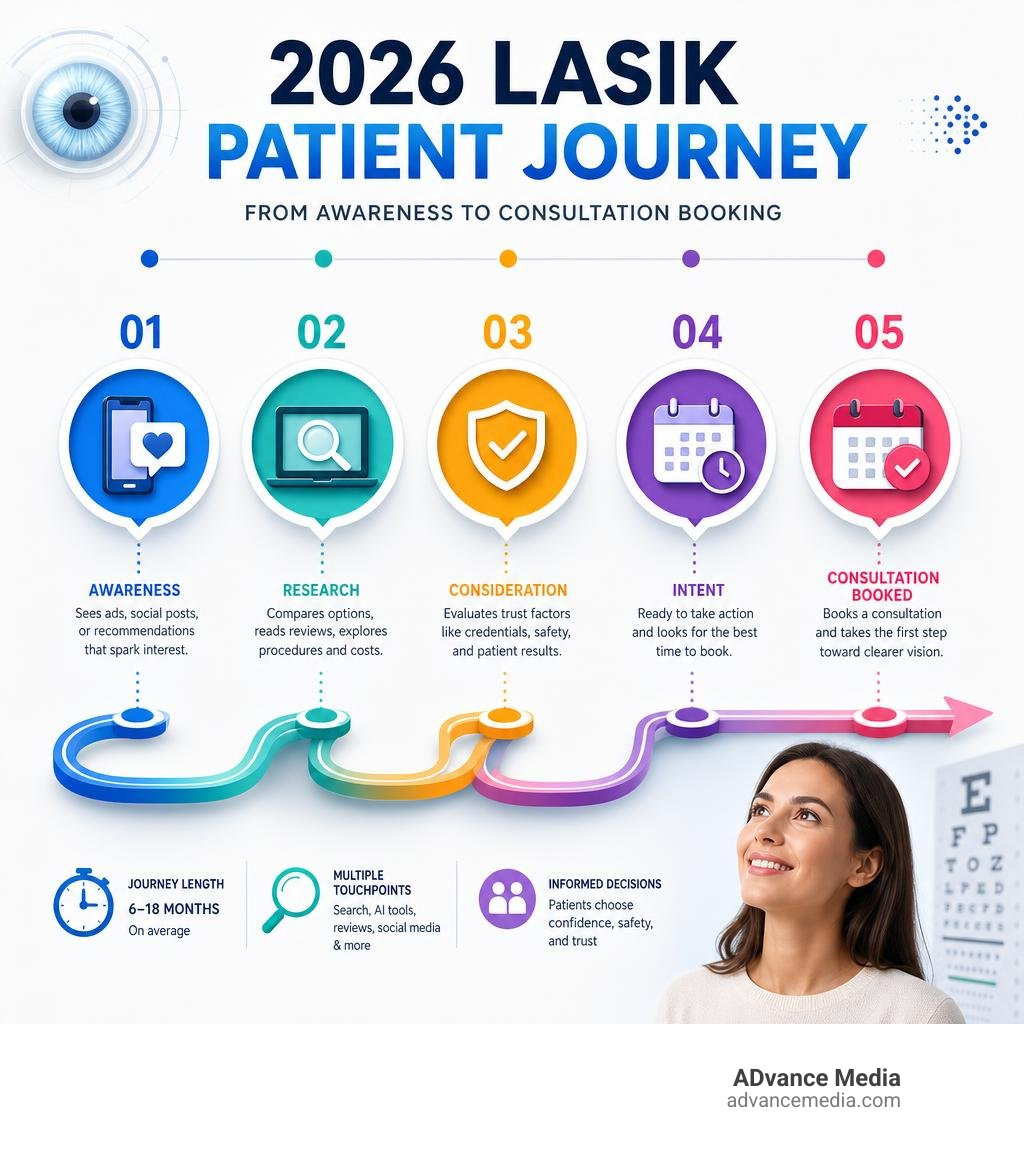
- The patient journey is longer than you think. The average LASIK prospect researches for 6 to 18 months across search, AI tools, reviews, and social media before booking a consultation.
- ROI benchmarks are maturing. In 2026, a healthy cost per qualified LASIK lead runs between $90 and $250, with a customer acquisition cost of $1,500 to $3,500, making every wasted ad dollar count.
The LASIK market is growing. The global market was valued at $2.3 billion in 2023 and is projected to expand at a 5.12% compound annual growth rate through 2033. With over 700,000 procedures performed in the US each year and 1,481 eye surgery clinics competing for those patients, the margin for sloppy or non-compliant advertising is essentially zero.
The clinics that win are not just the ones spending the most. They are the ones spending correctly.
I’m Tom Sullivan, and in this guide I’ll walk you through exactly what compliant, high-performing LASIK paid advertising looks like in 2026, from regulatory landmines to platform strategy to landing page architecture.
Navigating Regulatory Pitfalls and Compliance in LASIK Advertising
If you think regulatory compliance is just a headache for your legal team, think again. In 2026, compliance is a core marketing metric. A single flagged ad can lead to account suspensions, massive fines, and irreparable damage to your clinic’s local reputation.
A prime example of this is the landmark Advertising Standards Authority (ASA) ruling on Health Line in early 2025. The regulatory body cracked down on social media ads that promised unrealistic outcomes, failed to disclose risk, and redirected users to “parked domains” rather than genuine medical clinics. This ruling, triggered primarily by automated “Active Ad Monitoring” systems, demonstrated that regulators are actively scanning paid media with AI to catch non-compliant elective medical ads.
To keep your campaigns running smoothly, you must align your copy with the CAP Code (Edition 12) rules on misleading advertising, substantiation, and exaggeration, as well as the Federal Trade Commission (FTC) and Food and Drug Administration (FDA) guidelines in the United States. According to the FDA, LASIK ads must warn consumers of risks: FDA, meaning a balanced presentation of benefits and potential complications is legally required.
When planning your ad campaigns, keep this checklist of regulatory pitfalls in mind:
- Failing to disclose risks: You cannot present LASIK as a risk-free miracle.
- Exaggerating candidacy: Stating or implying that LASIK is suitable for everyone or can fix all vision problems is highly non-compliant.
- Obscuring commercial intent: It must be immediately obvious that your ad is a promotional piece, not an unbiased scientific article.
- Lacking clinical evidence: Any claim of clinical superiority or specific success rates must be backed by robust, peer-reviewed clinical data. To understand how to separate marketing hype from medical reality, read the guide on LASIK Advertising: Separating Fact from Fiction.
The Danger of Absolute Claims in the Future of Paid Ads for LASIK Clinics
We all want our ad copy to be punchy. “Throw away your glasses forever!” sounds incredibly compelling. However, in the future of paid ads for LASIK clinics, using absolute terms like “permanent freedom” or “no side effects” is the fastest way to get your ad accounts banned.
Regulators maintain that consumers interpret “permanent freedom” as a literal, lifelong guarantee that they will never need corrective lenses again. In reality, natural aging processes like presbyopia eventually affect almost everyone, meaning the claim cannot be substantiated. Similarly, asserting that a surgical procedure has “no side effects” is medically impossible and legally indefensible. Every surgery carries risk, whether it is temporary dry eye, night glare, or halos.
The FTC has shown it has no problem taking aggressive action against deceptive practices. In late 2024, the commission distributed over $1.1 million in refunds to consumers harmed by deceptive bait-and-switch LASIK advertising, as detailed in the official announcement: FTC Sends More Than $1.1 Million in Refunds to …. If your ads make promises your medical reality cannot keep, the financial and legal penalties will be severe.
Balancing Compelling Copy with Risk Disclosures
How do you write copy that actually converts while remaining completely compliant? The key is balance. You can highlight the life-changing benefits of laser vision correction, such as convenience, athletic freedom, and clear vision, as long as those claims are immediately qualified with realistic expectations and risk disclosures.
Instead of writing:
“Get permanent 20/20 vision with zero risks and no side effects. Book your free consultation today!”
Try writing:
“Tired of dry contacts during your workouts? LASIK has helped millions achieve clear, functional vision. While most patients see dramatic improvements, results vary, and temporary side effects like dry eyes or night glare can occur. Click to read our candidacy guide and book a thorough clinical evaluation.”
This compliant copy shifts the focus from an absolute guarantee to an educational invitation. It positions your clinic as an ethical, patient-first provider. If you want to build campaigns that convert high-intent patients without crossing regulatory lines, explore our specialized digital advertising services.
Landing Page Architecture and Lead Generation Transparency
Your ad copy might be perfect, but if your landing page fails to deliver a transparent, high-quality user experience, your conversion rates will tank, and search engines may penalize your quality scores.
In 2026, transparency is paramount. Your landing page must make it immediately clear whether you are a direct medical provider (an actual clinic with surgeons) or a third-party referral service. Deceptive lead-generation models that masquerade as independent directories or clinical registries without clear affiliate disclosures are primary targets for regulatory action.
To build trust above the fold, your landing page should quickly answer the most critical questions a prospective patient has. We detail this exact framework in our guide on 5 Questions Every Refractive Surgery Site Should Answer Above the Fold. Your landing page must state who you are, where you are located, what procedures you offer, how patients can qualify, and what the next steps are.
Avoiding the Pitfalls of Parked Domains and Deceptive Lead Gen
One of the most egregious violations flagged in recent regulatory sweeps is the use of “parked domains” or generic lead-capture pages in paid ads.
Domain parking involves registering a domain name and hosting basic, ad-heavy content to collect impression-based revenue or harvest user data. Some predatory advertisers run social media ads promising “free LASIK consultations” or “local vision screenings,” only to redirect users to a parked domain or a generic web form that sells their personal information to the highest bidder.
To stay compliant and build long-term brand equity, your paid ads must link directly to an active, secure, and fully branded website. If you use lead-generation forms, you must include:
- Clear commercial intent: Explicitly state that the form is for scheduling a consultation at your specific clinic.
- Prominent privacy policies: Disclose how patient data is stored and used.
- Explicit opt-ins: Require users to actively check a box to receive SMS or email communications, ensuring compliance with TCPA and healthcare privacy standards.
The Future of Paid Ads for LASIK Clinics: Platform Policies and Targeting Strategies
The technical landscape of paid advertising is shifting beneath our feet. Modern privacy standards, such as the legal flux of HIPAA web tracking guidance and the implementation of Consent Mode v2, mean that traditional browser-based tracking pixels are no longer safe for healthcare providers.
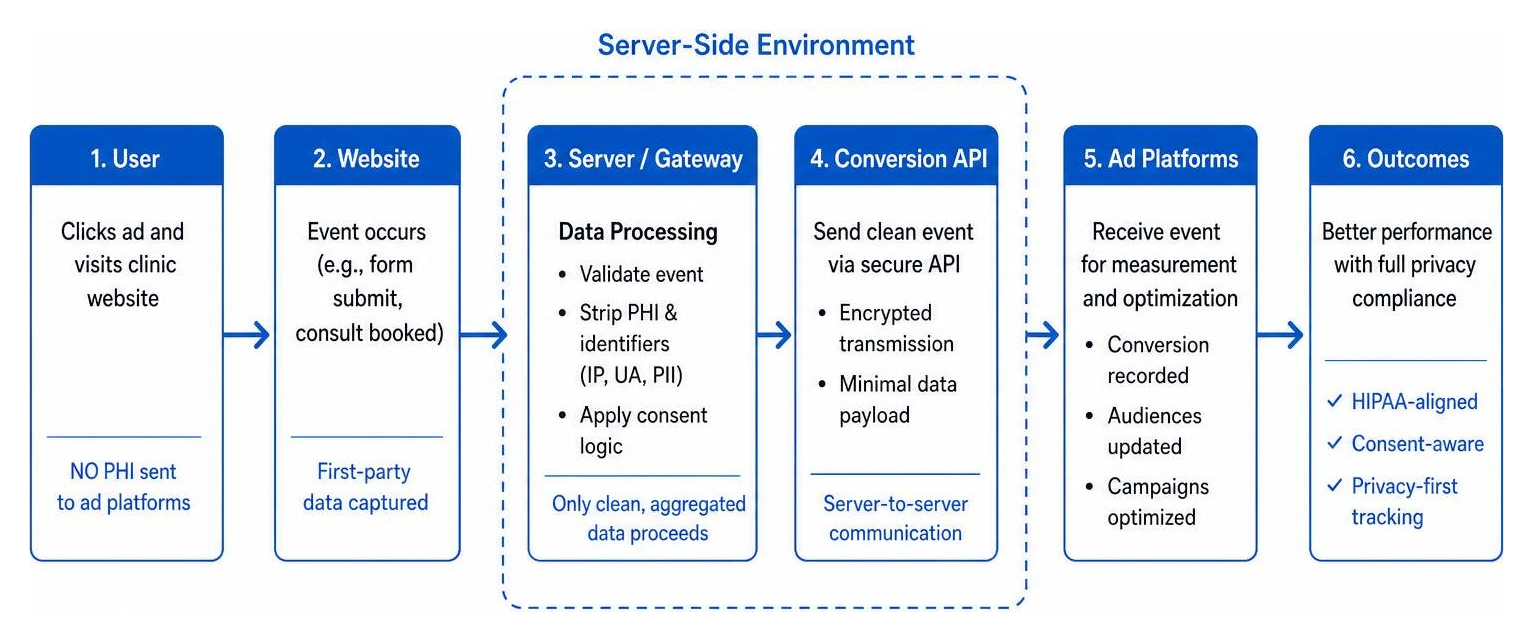
To run high-performing campaigns in 2026, we must transition to server-side tracking. Standard browser pixels (like the basic Meta Pixel) can inadvertently transmit Protected Health Information (PHI), such as IP addresses combined with visits to specific procedure pages, to third-party ad platforms, violating HIPAA. Server-side tracking acts as a secure gateway, stripping out sensitive identifiers before sending clean conversion signals to Google and Meta.
To help you decide where to allocate your media budget, let’s compare the two dominant advertising platforms for LASIK clinics:
| Feature / Metric | Google Ads (Search) | Meta Ads (Facebook & Instagram) |
|---|---|---|
| Primary User Intent | High-intent (active searchers) | Discovery / Awareness (passive scrolling) |
| Targeting Method | Keywords, Location, Search Intent | Demographics, Interests, Lookalikes |
| Compliance Risk | Moderate (Speculative treatment flags) | High (Strict personal health policy) |
| Best Use Case | Capturing active, ready-to-book patients | Nurturing mostly early-stage researchers with some hotter leads |
To maximize your ROI, we recommend a balanced approach that leverages the strengths of both platforms. For a deep dive into how to manage these campaigns, check out our resource on Google Ads Management and our comparative guide on Google vs Facebook Ads: Which Is Better for Aesthetic Practices.
Hyper-Local and Demographic Targeting in the Future of Paid Ads for LASIK Clinics
Because LASIK is an in-person surgical procedure, your targeting strategy must be hyper-local. Approximately 40% of all Google searches for medical services utilize location-modified terms (e.g., “LASIK surgeon near me”).
To capture this traffic efficiently:
- Use tight geo-segmentation: Limit your search campaigns to a realistic driving radius (typically 15 to 30 miles around your clinic locations).
- Target the right age demographic: The sweet spot for LASIK is adults aged 20 to 40. For older demographics (aged 40+), shift your ad creative to focus on Refractive Lens Exchange (RLE) or Custom Lens Replacement (CLR).
- Align with search intent: Do not waste budget on broad-match keywords like “eyes” or “glasses.” Focus on high-intent, long-tail terms like “best LASIK surgeon in [City]” or “SMILE eye surgery cost.”
If your ads are generating clicks but your waiting room is still empty, you might be suffering from poor targeting or offline lead leakage. Read our analysis on Why Your Google Ads Report Looks Good But Your Practice Doesn’t Feel Busier to diagnose and fix this common issue.
Compliant Social Media Advertising on Meta Platforms
Meta platforms (Facebook and Instagram) offer incredible visual storytelling opportunities, but they also feature some of the strictest healthcare policies in the world. Meta utilizes a 3-tier data restriction system for health-related ads, which limits your ability to retarget users based on specific medical conditions.
To run compliant Meta ads:
- Focus on lifestyle and convenience: Show active, happy patients enjoying life without glasses (e.g., swimming, traveling, playing sports).
- Avoid “before and after” eye close-ups: Extreme close-ups of medical procedures or eyes can be flagged as sensational content.
- Use lead-generation forms natively: Keep the initial contact within Meta’s compliant ecosystem, ensuring you collect explicit consent for follow-ups.
- Avoid automated black-box campaigns: While Google’s Performance Max can be tempting, it often obscures search-term data and wastes budget on non-refractive queries. Learn more in our breakdown: Google Performance Max Ads: Game Changer or Scam for Aesthetic Practices.
Building Trust and Transparency to Differentiate Your Clinic
In a highly competitive market with 1,481 clinics in the US alone, patients do not choose a surgeon based on a flashy ad. They choose based on trust.
Because LASIK is a highly consequential, elective surgery, the average patient passes through 10 to 20 invisible touchpoints, including reading reviews, watching video testimonials, and comparing local providers, before they ever submit a lead form. We call this journey the “hidden funnel.” To understand how modern patients actually make this decision, read our comprehensive guide on The Hidden Funnel: How Patients Actually Choose a Refractive Surgeon in 2026.
Leveraging Patient Reviews and Outcomes Compliantly
Online reviews are the lifeblood of your digital reputation, with a majority of patients valuing them as much as personal recommendations. However, displaying reviews in your paid advertising requires strict adherence to HIPAA and FTC guidelines:
- Never share Protected Health Information (PHI): Even if a patient posts a detailed review on Google, you cannot copy that text and use it in a paid Facebook ad with their full name and photo unless you have a signed, HIPAA-compliant media release form.
- Be transparent about outcomes: Do not cherry-pick only “perfect 20/20” testimonials. Compliantly showcase a realistic range of positive patient experiences, including their recovery journeys.
- Optimize for generative search: In 2026, structured patient reviews do not just influence human beings; they act as critical data inputs for generative AI engines (like ChatGPT, Perplexity, and Google AI Overviews) that recommend local clinics.
To learn why traditional keyword rankings are no longer enough to keep your consultation calendar full, explore our strategic playbook: Why Good SEO Is Not Enough for Refractive Surgery Practices Anymore.
Frequently Asked Questions about LASIK Paid Advertising
Can LASIK ads claim ‘no side effects’ or ‘permanent freedom’?
No. All surgical procedures carry inherent risks and potential side effects, such as temporary dry eyes, glare, or halos. Claiming “no side effects” or promising “permanent freedom” misleadingly exaggerates the safety and longevity of the treatment, violating FTC, FDA, and ASA guidelines. Ads must present a balanced view, acknowledging potential risks alongside the benefits.
Is it acceptable to advertise a free consultation if the link leads to a parked domain?
Absolutely not. Directing users to a parked domain or a generic, unbranded lead-capture page violates platform policies and advertising standards. It misleads consumers about the nature of the service, suggesting they are booking directly with a clinical provider when they are actually being directed to a lead-harvesting site. Ads must link to an active, secure, and clearly branded clinical website.
How can LASIK clinics track ad conversions without violating HIPAA?
To track conversions compliantly, clinics should transition from browser-based tracking pixels (which can transmit sensitive user data like IP addresses and page visits to ad platforms) to secure, server-side tracking. By using server-side conversion APIs combined with BAA-backed analytics tools, clinics can strip out personal identifiers before sending clean, compliant performance data to Google and Meta.
Conclusion
The landscape of paid ads for LASIK clinics in 2026 demands a sophisticated blend of creative marketing, technical tracking, and strict regulatory compliance. The days of running simple “throw away your glasses” ads with basic tracking pixels are over.
To succeed today, your clinic must:
- Eliminate absolute, unsubstantiated claims from your ad copy.
- Build transparent, high-converting landing pages that put patient education first.
- Implement HIPAA-compliant server-side tracking to secure your data pipeline.
- Nurture patients through the “hidden funnel” with authentic, legally compliant trust signals.
At ADvance Media, we act as your outsourced Chief Digital Marketing Officer. We do not just look at superficial click metrics; we focus on trackable ROI, helping elective medical practices build robust, compliant, and highly profitable patient acquisition engines.
Is your LASIK clinic looking to grow? Just drop us a note here to get in touch and see how we can help audit your marketing and acquisition strategy to build a foundation for growth this year and beyond.
Share this post


